
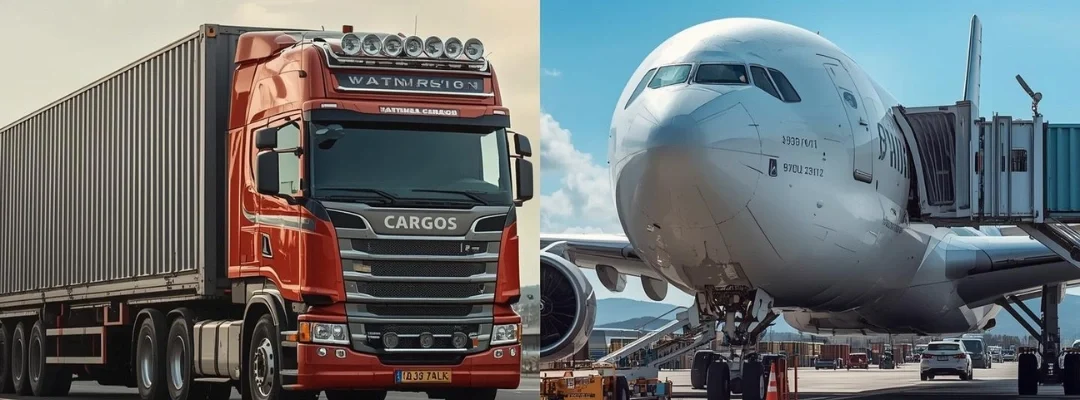
Choosing the right transport mode is important for businesses that depend on timely and efficient goods movement. Two common logistics options are truck cargo and air cargo. Both play an important role in cargo transportation, but they serve different purposes based on urgency, shipment size, destination, cargo type, and budget.
Understanding truck cargo vs air cargo helps businesses select the most practical transport solution. Truck cargo is known for flexibility, wider delivery reach, and cost-effectiveness, while air cargo is preferred for urgent and time-sensitive shipments.
What Is Truck Cargo?
Truck cargo refers to the transportation of goods by road using commercial trucks, container trucks, mini trucks, trailers, and other cargo vehicles. Truck cargo services are widely used for local, regional, and interstate transport. They help move goods directly between factories, warehouses, distributors, retail outlets, and customer locations.
Truck cargo is suitable for industries such as manufacturing, retail, FMCG, e-commerce, construction, and industrial supply.
What Is Air Cargo?
Air cargo refers to the transportation of goods by aircraft. It is mainly used for urgent, time-sensitive, high-value, or lightweight shipments that need faster delivery. Air cargo services are commonly used for domestic express transport and international freight movement.
Businesses often use air cargo for medical supplies, electronics, urgent spare parts, documents, and other critical goods.
Truck Cargo vs Air Cargo: Main Difference
The main difference between truck cargo and air cargo is that truck cargo focuses on road-based flexibility and direct delivery, while air cargo focuses on speed and urgent long-distance movement.
In simple terms:
- Truck cargo is better for regular, heavy, and large-volume shipments
- Air cargo is better for urgent, lightweight, and high-value shipments
1. Speed of Delivery
Air cargo is much faster than truck cargo and is the better option when delivery time is critical. It is ideal for emergency shipments, urgent business deliveries, and international transport.
Truck cargo is slower compared to air transport, but it is reliable for planned deliveries and regular supply chain movement.
- Air cargo advantage : Faster delivery,Best for urgent consignments,Suitable for time-sensitive cargo
- Truck cargo advantage : Reliable for regular deliveries,Better for planned logistics,Practical for non-urgent shipments
2. Cost Comparison
Truck cargo is generally more economical and is better suited for businesses that need practical transport at lower cost. This makes it highly useful for regular commercial and industrial shipments.
Air cargo is usually more expensive because of freight charges, airport handling, documentation, and limited cargo space.
- Truck cargo advantage: Lower transport cost,Better for routine dispatches,Cost-effective for bulk and commercial goods.
- Air cargo limitation: Higher freight cost,Less suitable for cost-sensitive shipments
3. Shipment Volume and Load Capacity
Truck cargo is highly suitable for large, heavy, and bulky consignments. It is commonly used for full truck load, part load, machinery, construction materials, and bulk goods.
Air cargo is more suitable for smaller, lighter, and high-value shipments. Although some heavy cargo can move by air, it is more restricted and expensive.
- Truck cargo best for: Heavy materials,Bulk goods,High-volume shipments,Industrial cargo.
- Air cargo best for: Small urgent shipments,Lightweight products,High-value goods,Critical items
4. Delivery Reach and Accessibility
Truck cargo services offer better route flexibility and direct delivery reach. Trucks can provide door-to-door transport and access factories, warehouses, project sites, retail locations, and customer destinations directly.
Air cargo is limited to airport-based transport. Goods usually still require truck transport before and after the flight.
- Truck cargo advantage: Door-to-door delivery,Better route access,Suitable for city, industrial, and remote locations
- Air cargo limitation: Airport-to-airport movement,Requires road transport support for final delivery
5. Suitability for Different Cargo Types
Truck cargo supports a wide range of goods and industries. It is commonly used for construction materials, FMCG products, machinery, commercial stock, retail goods, and industrial supplies.
Air cargo is more suitable for goods where speed and value matter more than size or cost.
- Truck cargo commonly used for: Construction materials,FMCG and retail goods,E-commerce products,Industrial materials,Machinery and commercial cargo
- Air cargo commonly used for: Medical supplies,Electronics,Urgent spare parts,Fashion products,Documents and high-value items
6. Handling and Transport Process
Truck cargo usually involves a simpler transport process because goods can often be loaded once and delivered directly to the destination. This reduces extra handling in many cases.
Air cargo involves airport procedures, documentation, security checks, airline handling, and destination coordination before final delivery.
- Truck cargo advantage: Simpler point-to-point transport,Fewer handling stages,Better for direct movement
- Air cargo limitation: More formal procedures,Additional coordination required.
7. Domestic and International Use
Truck cargo is mainly used for domestic transport, including local, regional, and interstate delivery. It is ideal for direct commercial movement within India.
Air cargo is used for both domestic urgent shipments and international freight. It is especially useful when goods must move quickly over long distances or across countries.
- Truck cargo best for: Domestic cargo transport,Regional and interstate distribution,Door-to-door commercial supply
- Air cargo best for: International freight,Urgent long-distance delivery,High-priority shipments
8. Flexibility in Logistics Planning
Truck cargo offers greater flexibility because businesses can choose the vehicle type, route, and delivery schedule based on actual needs. This makes truck cargo useful for different shipment sizes and changing supply requirements.
Air cargo is less flexible because it depends on flight schedules, airport operations, cargo restrictions, and airline processes.
- Truck cargo advantage: Better control over delivery planning,Flexible for different business needs,Suitable for varied cargo volumes.
- Air cargo limitation: Dependent on airline schedules,Less flexible for route-based planning
When Truck Cargo Is Better
Truck cargo is the better choice when:
- The shipment is heavy or bulky
- Door-to-door delivery is needed
- Cost control is important
- The cargo is part of regular supply chain movement
- Goods need to move within a city, state, or across India
- The shipment is not extremely urgent
When Air Cargo Is Better
Air cargo is the better choice when:
- Delivery is urgent
- The product is lightweight and high value
- Delay may affect business operations
- The shipment is international or time-sensitive
- The cargo includes emergency medical, electronics, or critical spare parts
Can Truck Cargo and Air Cargo Work Together?
Yes. In many logistics operations, truck cargo and air cargo work together. Trucks are used for first-mile pickup and last-mile delivery, while aircraft handle the long-distance or urgent middle segment.
For example, goods may be picked up from a warehouse by truck, moved to the airport, flown to another city, and then delivered by truck to the final destination.
Which Is Better: Truck Cargo or Air Cargo?
There is no single answer because the better option depends on the shipment. If speed is the top priority, air cargo is the better choice. If the business needs direct delivery, lower cost, larger load capacity, and better route flexibility, truck cargo is usually the better option.
For many day-to-day business needs, truck cargo is more practical. For urgent and critical deliveries, air cargo becomes more valuable.
Why Choose Us for Cargo Transport Solutions
Skyroots Logistics, we help businesses select the right transport solution based on shipment size, urgency, route, and cargo type. Whether the need is for regular truck cargo movement or urgent transport planning, we focus on practical and dependable logistics support.
Why choose Skyroots Logistics:
- Reliable transport support for different shipment needs
- Practical solutions based on cargo size and urgency
- Flexible truck cargo options for regular business movement
- Support for industrial, retail, FMCG, and commercial goods
- Better delivery planning for smoother logistics coordination
- Suitable transport support for small and large business requirements
With Skyroots Logistics, businesses get cargo transport solutions designed for better movement, improved planning, and dependable service.
FAQ About Truck Cargo vs Air Cargo
What is the main difference between truck cargo and air cargo?
Truck cargo is more flexible and cost-effective for road transport, while air cargo is faster and better for urgent shipments.
Which is cheaper, truck cargo or air cargo?
Truck cargo is generally cheaper than air cargo, especially for heavy, bulky, and regular commercial shipments.
Which is faster, truck cargo or air cargo?
Air cargo is much faster and is preferred for urgent or time-sensitive deliveries.
Which is better for heavy goods, truck cargo or air cargo?
Truck cargo is usually better for heavy goods because it can handle larger and bulkier shipments more practically and at lower cost.
Is truck cargo better for domestic transport?
Yes. Truck cargo is often better for domestic transport because it supports direct city-to-city and door-to-door delivery.
When should a business choose air cargo?
A business should choose air cargo when the shipment is urgent, lightweight, high value, or time-sensitive.
Can truck cargo and air cargo be used together?
Yes. Many businesses use truck cargo for pickup and final delivery, while air cargo is used for the faster main transport segment.
Which industries use truck cargo more than air cargo?
Industries such as construction, FMCG, manufacturing, retail, e-commerce, and industrial supply commonly use truck cargo more for regular goods movement.
Recent Comments